
Working to improve mutual understanding between the Middle East and the West
No products in the basket.
Hospitality as a Means to Deepen the Encounter
Büyükada, Istanbul, Turkey
Monday, 31 August – Thursday, 3 September Convened by: Lindsay Simmonds, Imran Khan & Elena Dini
With Emeriti Conveners: Julie Siddiqi, Benjamin Kamine and Angeliki Ziaka
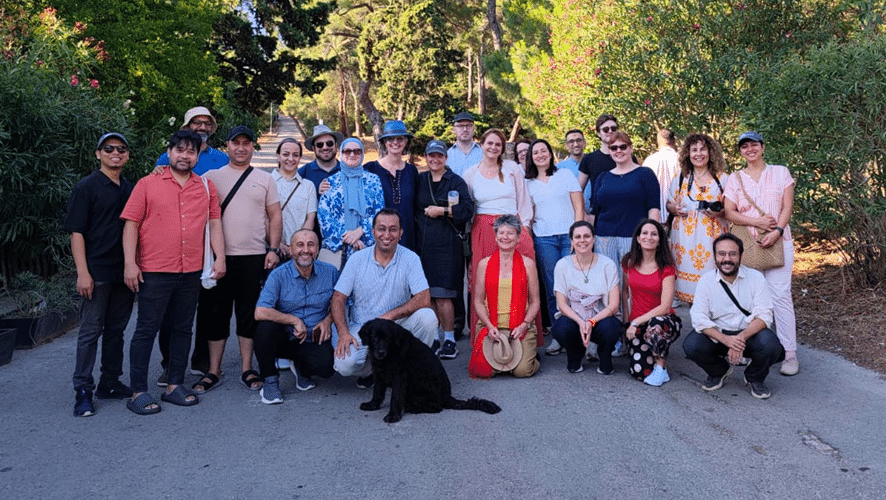
Having made journeys long and short from around the world, our group of thirty convened on Büyükada, an island in the Sea of Marmara. Among our number were academics and faith leaders from the three major Abrahamic religions. We had gathered for four days of discussion and activities on the theme of hospitality: how it unites and perhaps divides us, and how it can be a way to build deeper connections between faith traditions.
Over the course of our stay, this group of strangers came together, shared traditions with each other, ate together, made pilgrimage, sang songs, laughed, discussed and, naturally, argued. We invited speakers into our circle and went to meet local religious figures. As we considered hospitality, each in turn received and gave it: while GINGKO had the enormous privilege of welcoming all to the retreat, each of our fellows played host in their own way, sharing ideas with guests as bread freely given.
From GINGKO’s perspective, we saw a very successful retreat, a feeling echoed by the fellows themselves, who, in anonymous feedback, all reported feeling more comfortable / better equipped to have a challenging conversation with a person of their own faith and those of another faith. In individual comments, participants reported feeling a greater depth of appreciation for hospitality itself, and a belief in the possibility of dialogue between people who would not normally talk. Asked what they had learnt during their time, one respondent wrote: “EVERYTHING! Open up and not be afraid, make great and close connections with people. It is unlimited how you can learn from that. I want to bring this openness and curiosity into my everyday life.”
Though the island paradise afforded us the time and space to consider hospitality in the abstract, the larger world was never far from our minds. What hospitality means in our time of war, and how to show it to those who deny it to us, were continual considerations. Everyone enriched the discussion with insights from their own context, but some brought a depth of thought from places where hospitality, like everything, becomes complicated by crisis. We owe special thanks to those who shared from their immediate contexts in Iran, Iraq, and Israel/Palestine. The reflections of one fellow, Mayaan Raveh, on hospitality in concept and in the Israeli/Palestinian context are particularly pertinent, and GINGKO is honoured to share them here.
Memories of population displacement, and hospitality as a question of history, permeated the retreat. As we climbed to the highest point on the Island, undertaking a collective pilgrimage to the Aya Yorgos monastery, a shared Christian/Muslim holy site, to be welcomed by the Hieromonk Ezekiel, one of Istanbul’s remaining Greek Orthodox monks, a community largely displaced in the “population exchanges” after WWI. Walking past the ruin of an enormous wooden Greek orphanage was one of many moments where we understood how our theme of hospitality was more profound than it may first appear.
As we approached the monastery, we observed the traditional pilgrimage rituals. In small interfaith groups, we silently unfurled a spool of string tied to the bottom of the hill; in local legend, if the string reached the monastery unbroken, a wish may be granted.
Said Mahathir, one of our fellows, wrote a moving account of this journey and our unexpected companions, entitled The Pilgrims and the Dogs.
We all blurred the lines of guests and hosts; as hosts we welcomed each other into the spaces, texts, and practices of our religions in spiritual sharing sessions, and extended that welcome to guest speakers, Dr Claudio Monge, director of the Dominican Study Institute in Istanbul, and Dr Elif Tokay from the Faculty of Theology at Istanbul University.
And in so many ways were we guests also, guests of the hotel, of the island, of Turkey. In the monastery we were the guests of Brother Ezekiel, and later in Adalar of his Eminence Metropolitan Dimitrios. Thanks are owed to our emerita convener Angeliki for facilitating these meetings, not least through her translations to and from Greek. Her report for the World Council of Churches is available here. After the retreat, most fellows stayed on in Istanbul and were welcomed to the Neve Shalom Synagogue and the Quincentennial Foundation Museum of Turkish Jews, where we were the guests of Nisya Isman Allovi, Director and curator of the museum – none of which would have been possible without Lindsay Simmonds’ work connecting us.
Hospitality as a living practice forms the web of GINGKO, which enables extraordinary experiences. Everything that made the retreat special and successful was achieved through networks of people all acting as guest and host in turn, willing to welcome strangers.