
The Pilgrims and the Dogs
Hospitality On the Road to Aya Yorgi
By Said Mahathir
We began our pilgrimage walk in the morning, shortly after breakfast.
The evening before, we had been advised to prepare carefully for the pilgrimage: wear light clothes for the summer heat, put on comfortable walking shoes, carry enough water, and consider our physical condition before deciding whether to make the journey. From the Splendid Palas Hotel on Büyükada, we walked to Aya Yorgi (Saint George) Church and Monastery, situated at the top of Yücetepe Hill. The trip took several hours and covered about seven kilometres round trip.
We came from different countries, cultures, and religious traditions to participate in an interfaith retreat organised by GINGKO. This year, the dialogue’s theme revolves around the concept of ‘Hospitality as Means to Deepen Encounter’. During the retreat, we explored hospitality through religious texts, conversations, meals, and visits to sacred places. The pilgrimage to Aya Yorgi offered another way of thinking about the theme: we entered a religious space belonging to a tradition that was, for many of us, not our own.
In that sense, we were pilgrims, but we were also guests.
Yet somewhere on the road to Aya Yorgi, two dogs complicated this simple distinction between guest and host.
The Road to Aya Yorgi
At the beginning, we walked more or less together. Gradually, however, our different bodies established different rhythms. Some walked quickly and followed the local guide. Others formed a middle group. A few of us fell further behind, while some eventually decided not to complete the climb.
The pilgrimage had begun as a collective journey, but the road slowly stretched us apart.
Then two dogs appeared.
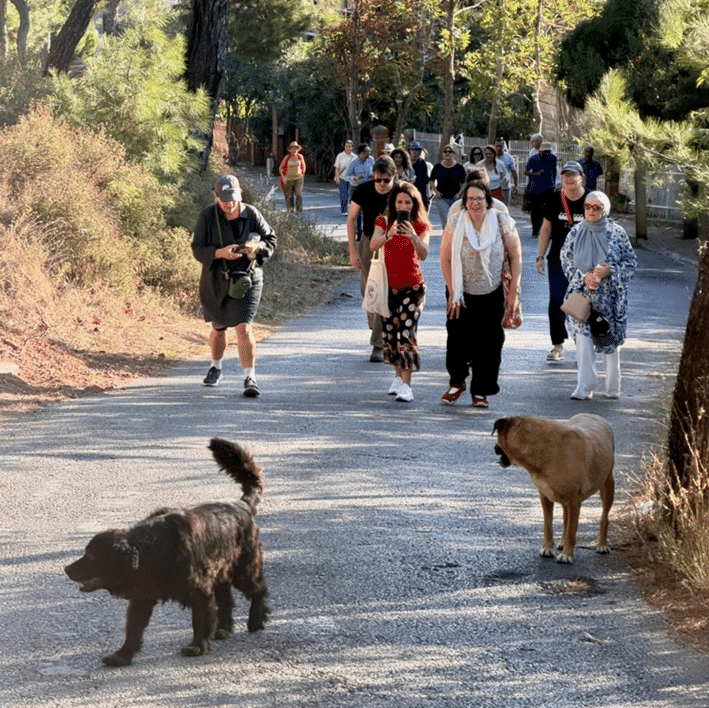
Figure 1: Unexpected companions on the road to Aya Yorgi. Two dogs joined the pilgrims during the ascent, their presence drawing attention across a group that had gradually dispersed according to different walking paces. Photograph by: Stefan Zeljkovic
At first, I assumed they were simply stray dogs wandering around the hill. They approached while some of us rested, and I thought they might be looking for food. Unfortunately, we had little to offer. Most of us were carrying only water. After taking a few sips, we continued our journey.
The dogs continued too.
Only after some time did we realise that they were following us.
Their presence subtly changed the pilgrimage’s atmosphere. The pilgrims began noticing them. Someone smiled at them. Others approached them or took photographs. Conversations began around them. Pilgrims who had been concentrating on the steep road, their own bodies, or reaching the monastery suddenly turned their attention towards these unexpected companions.
Something interesting happened.
The pilgrimage had separated us by pace, but the dogs gathered us once more. They became part of the journey – not as planned participants, not as guides, and certainly not as invited guests, but simply through their presence.
They walked with us for kilometres.
A Handful of Water
Neither dog was young. As we climbed higher, I noticed the brown one was panting; it seemed to be growing increasingly thirsty.
I still had water in my bottle and wondered how to share it with the dog. Should I cup my hand to give some? But then I immediately faced a small religious dilemma.
As a Muslim from Indonesia, I had been taught and practised specific rules concerning physical contact with dogs. In the tradition I follow, such contact may require a particular form of purification, which I knew as samak: washing the affected area seven times, including once with a mixture containing soil. I had no container into which I could pour the water for the dog, while offering it from my bare hand would potentially mean performing samak afterwards. We were still climbing the hill, and I did not know whether enough water would be available at the top for the purification.
For a moment, therefore, something very ordinary – giving water to a thirsty animal – became entangled with my religious practice.
Then I noticed a small plastic bag tied to a branch. I untied it and wrapped it around my hand like a glove.
When we reached the top, I poured water into my covered palm and let the dog drink.
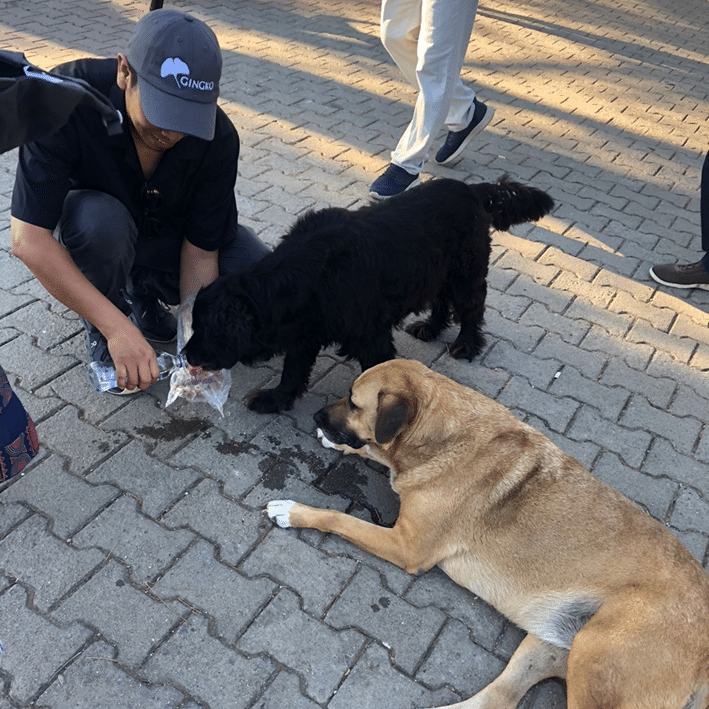
Figure 2: Sharing water. At the end of the climb, water carried for the pilgrimage was shared with the dogs – an ordinary gesture that became, for me, a moment to reflect on the shifting roles of guest and host. Photograph by: Natalie Mylonas FHEA
They were clearly thirsty.
I continued pouring until my bottle was empty.
The water I had carefully brought for my own journey was gone. I knew that I still had to walk all the way back to the hotel, but at that moment it seemed more important that the dog drink.
Other pilgrims noticed, and caring for the dogs gradually became a shared gesture. Someone found another solution: a baseball cap became a makeshift bowl, into which more water could be poured. Others contributed their water.
A collection of small acts emerged around an animal that none of us knew, and none of us had expected to encounter.
Looking back, I wonder whether this was one of the most important moments of our pilgrimage.
Who Is The Guest?
We had come to Aya Yorgi thinking of ourselves as guests.
This understanding seemed particularly appropriate for an interfaith retreat about hospitality. We entered another religious space respectfully. We encountered traditions, people and practices that were not necessarily our own. The monastery was the destination, and we were its visitors.
But the dogs reversed these roles.
They approached us without invitation. They had no place in our retreat programme and no role in our carefully planned interfaith encounter. Yet by walking alongside us, they presented us with a simple question: ‘If we are guests here, can we also become hosts?’
This is where I began to understand hospitality differently.
Hospitality does not necessarily begin with ownership of a house, a table, a monastery or any other physical place. To host someone, we first need to create a space ‘within ourselves’ that another being is permitted to enter (Monge,2024).
The host, in this sense, is not simply the person who owns the place.
The host is the person who makes space.
And the guest is not necessarily the person we expected to receive.
The dogs had nothing to offer us in the conventional language of hospitality. They did not invite us anywhere. They could not participate in our theological conversations. Yet their presence changed our relationships with one another and with the journey itself. They interrupted the pilgrimage precisely enough to make us notice what was around us.
Perhaps hospitality begins with this interruption.
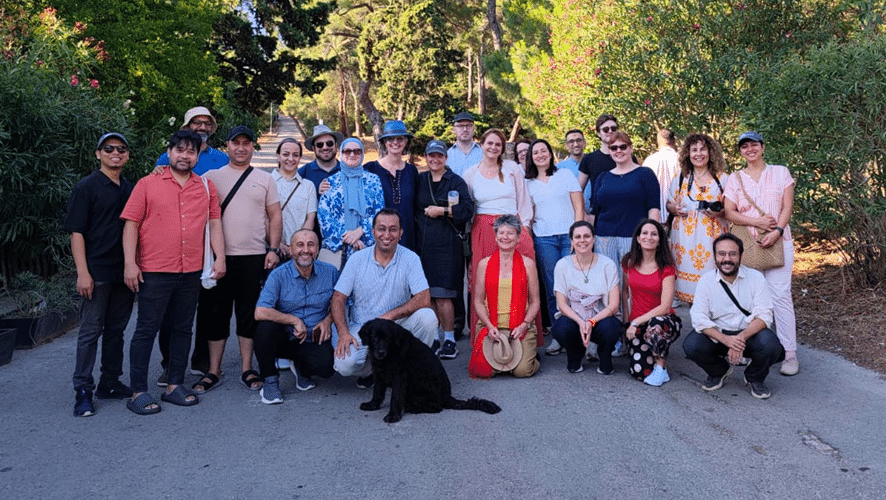
Figure 3: Pilgrims and companion. A group photograph during the journey, with one of the dogs settling among the pilgrims. What began as an unexpected encounter gradually became part of the shared experience of the pilgrimage.
Pilgrimage As Becoming a Host
Pilgrimage is often understood through its destination. One walks ‘towards’ somewhere: a shrine, a monastery, a temple, Mecca. The sacred place gives the journey its direction.
Yet walking to Aya Yorgi made me wonder whether pilgrimage should also be understood through what happens before we arrive.
If the pilgrim’s ultimate aspiration is to become a guest of the sacred, the road continuously asks the pilgrim to become a host.
To become a host to other pilgrims.
To become a host to strangers.
To become a host to discomfort.
And even to become a host to two thirsty dogs who unexpectedly decide to accompany the journey.
The destination therefore does not contain the entire meaning of pilgrimage. Meaning accumulates through walking: through tiredness, conversation, waiting for slower companions, losing sight of those ahead, sharing water, encountering animals and responding to circumstances that could never have appeared on an itinerary.
This raises another question for me as a Muslim.
One day, God willing, I hope to perform the Hajj.
Hajj is a pilgrimage with a clear sacred geography, prescribed rituals and a destination towards which millions of Muslims orient themselves. It is also physically demanding. Islam requires it only of those who are able to undertake it.
Modern technology has made parts of pilgrimage easier. Transport can shorten distances. Navigation can prevent us from getting lost. Air-conditioned spaces can protect us from heat. Phones allow us to document our movements and remain connected to people far away.
These are valuable forms of assistance, particularly for those who need them.
But my walk to Aya Yorgi Church and Monastery leaves me with another question: ‘What might disappear when the journey becomes only a problem to be made easier?’
The difficult road forced me to encounter my own body, my fellow pilgrims and the environment through which we travelled. The dogs were not at our destination. We encountered them because we were walking.
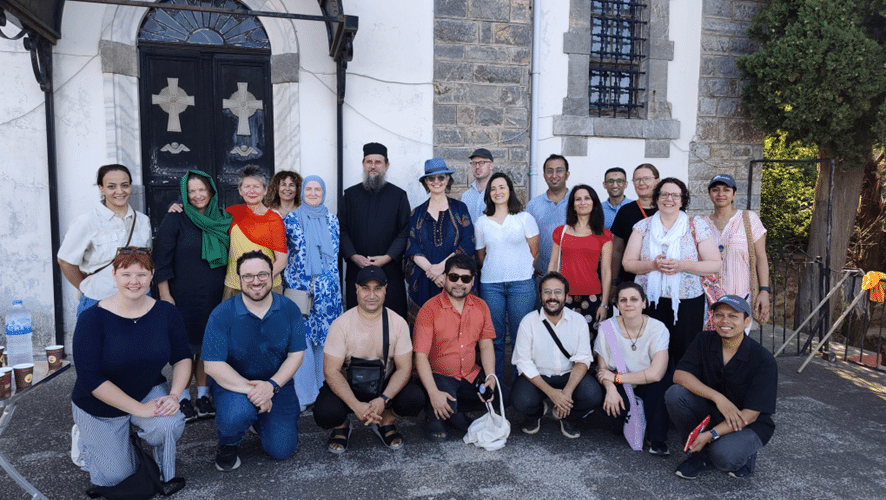
Figure 4: Arriving as guests at Aya Yorgi. The pilgrims gathered with their host after reaching Aya Yorgi Church and Monastery, the destination of the pilgrimage and a space of encounter within the interfaith retreat.
We eventually reached Aya Yorgi.
But the pilgrimage is not only about arriving at a sacred place where we hope to encounter God. The journey itself asks what kind of person arrives there.
Perhaps the road towards God is also a continuous practice of making space for those we encounter along the way.